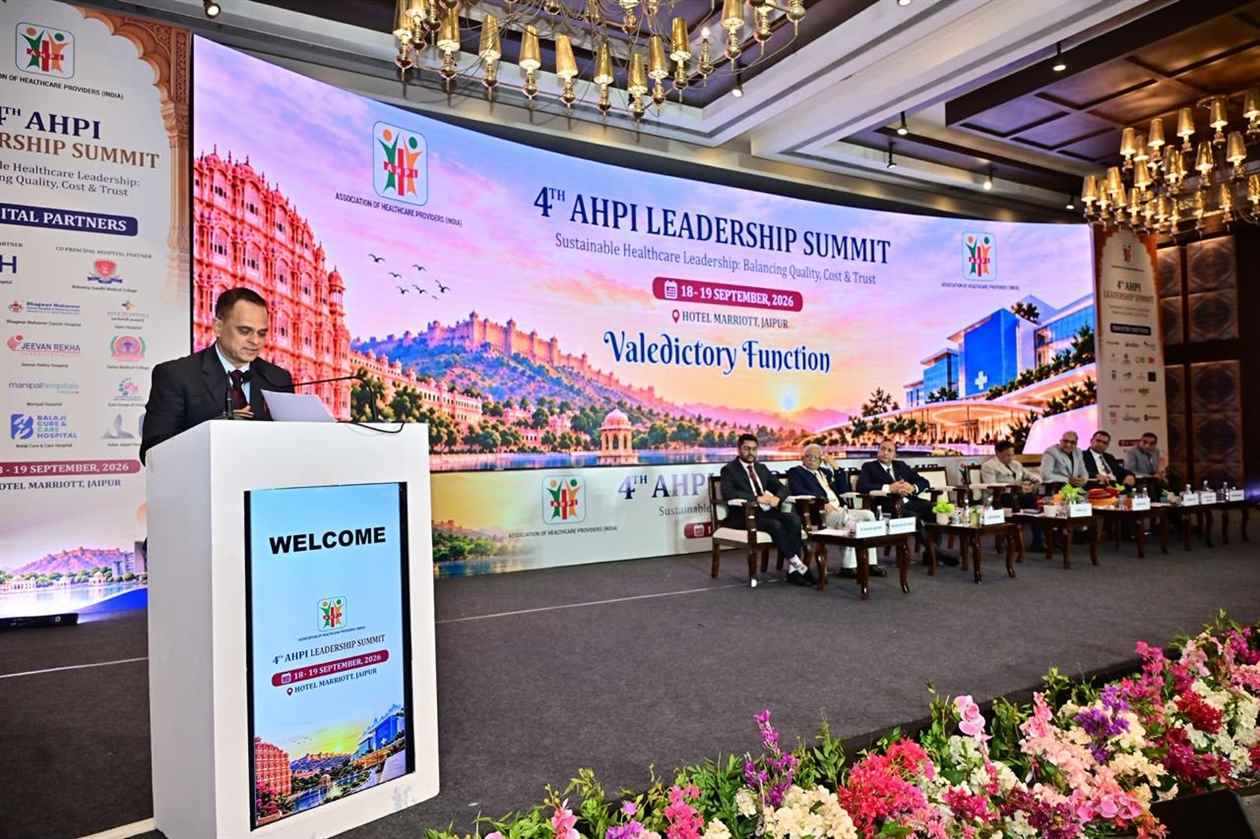
Chief Secretary Shri V. Srinivas said that the future of healthcare in Rajasthan should not be limited to constructing new hospitals. The State must develop a robust and integrated healthcare ecosystem that combines accessibility, quality, affordability, modern technology, skilled human resources and institutional trust. He emphasised that patients and their well-being must remain at the centre of every healthcare policy, institution, technology and investment.
The Chief Secretary was addressing the valedictory session of the Association of Healthcare Providers (India) National Leadership Summit 2026 as the Chief Guest in Jaipur on Saturday. He presented the State’s future healthcare roadmap on the theme, “Building Rajasthan’s Healthcare System for the Next Decade.”
A Healthy Rajasthan Will Strengthen the Vision of Viksit Rajasthan
Shri Srinivas said that the Viksit Rajasthan 2047 vision accords special priority to ensuring accessible, affordable and quality healthcare for every citizen. Improving maternal and child health, achieving universal immunisation, expanding medical education and research, strengthening Ayushman Arogya Centres and promoting the use of modern technology in healthcare are among the State’s key priorities.
He said that primary health centres, community health centres and medical colleges across the State are being continuously strengthened. Efforts are also being made to improve maternal and neonatal healthcare through the timely identification of high-risk pregnancies, appropriate counselling and an effective referral system. Special emphasis is being placed on the timely completion of major healthcare projects, filling vacancies and strengthening the capacities of healthcare professionals.
Advanced Healthcare Services Must Reach Smaller Cities
The Chief Secretary said that advanced healthcare facilities should expand beyond Jaipur and other major cities to regional centres and smaller towns. Hospitals, diagnostic facilities, specialist doctors, paramedical staff, emergency services, referral networks and digital connectivity need to be developed in an integrated manner.
This, he said, would reduce the need for patients to travel long distances for treatment while also creating skilled employment opportunities at the local level.
He emphasised that the State’s healthcare requirements cannot be met by the government or the private sector working independently. While the government provides scale, public financing and policy direction, the private sector contributes investment, modern technology, specialised services, innovation and managerial capabilities. Both sectors must work as complementary partners in the interest of patients.
Quality Must Grow Alongside Capacity
Shri Srinivas said that the expansion of healthcare services must be accompanied by a corresponding focus on quality. Patient safety, infection control, transparent outcomes, clinical accountability and continuous quality improvement should become integral to the working culture of every healthcare institution.
He said that healthcare institutions should move beyond minimum compliance and develop a culture of safety, accountability and excellence.
The Chief Secretary noted that while buildings and equipment can be created relatively quickly, developing skilled doctors, paramedical staff, technicians and competent healthcare administrators requires sustained, long-term efforts. The government, hospitals and educational institutions should collaborate on skill development, practical training, faculty development and continuing medical education.
Rajasthan Making Significant Progress in Digital Health
The Chief Secretary said that Rajasthan is rapidly advancing in the field of digital healthcare. The State ranks second in the country in the Healthcare Professional Registry, fifth in the Health Facility Registry and fourth in the generation of Ayushman Bharat Health Account (ABHA) identification numbers. Rajasthan has created 8.37 crore unique digital health records.
He said that the next phase of digital health should focus on the meaningful use of data and interoperability among different systems. Electronic health records would facilitate seamless patient services, provide doctors with better information and support the effective implementation of government health programmes.
Artificial intelligence can assist in clinical and administrative decision-making, he said, but human oversight, patient safety and accountability must always remain paramount.
The Chief Secretary said that Rajasthan has strong potential to emerge as a leading healthcare and medical tourism destination in North and Western India, owing to its connectivity, advanced medical services, medical education institutions, hospitality infrastructure and competitive costs. With coordinated efforts, the healthcare sector can become an important driver of investment, employment and skill development in the State.
Former Member of NITI Aayog Dr. Vinod K. Paul, Emeritus Chairperson of Mahatma Gandhi University of Medical Sciences and Technology Dr. M.L. Swarankar, Director General of the Association of Healthcare Providers (India) Dr. Girdhar Gyani, healthcare experts and representatives of various institutions attended the valedictory session.