Link agricultural produce with processing and markets to ensure better returns for farmers
39 Food Parks proposed under Rajasthan Food Park Development Policy-2026; land allocated at 35 locations
September 9
Chief Secretary Shri V. Srinivas emphasised the need to better link agricultural produce in the State with processing, markets and exports to ensure better returns for farmers. He directed that the proposed agro-processing clusters be mapped in detail, crop-wise and region-wise, to identify their economic, investment and export potential, and that a concrete action plan be prepared accordingly.
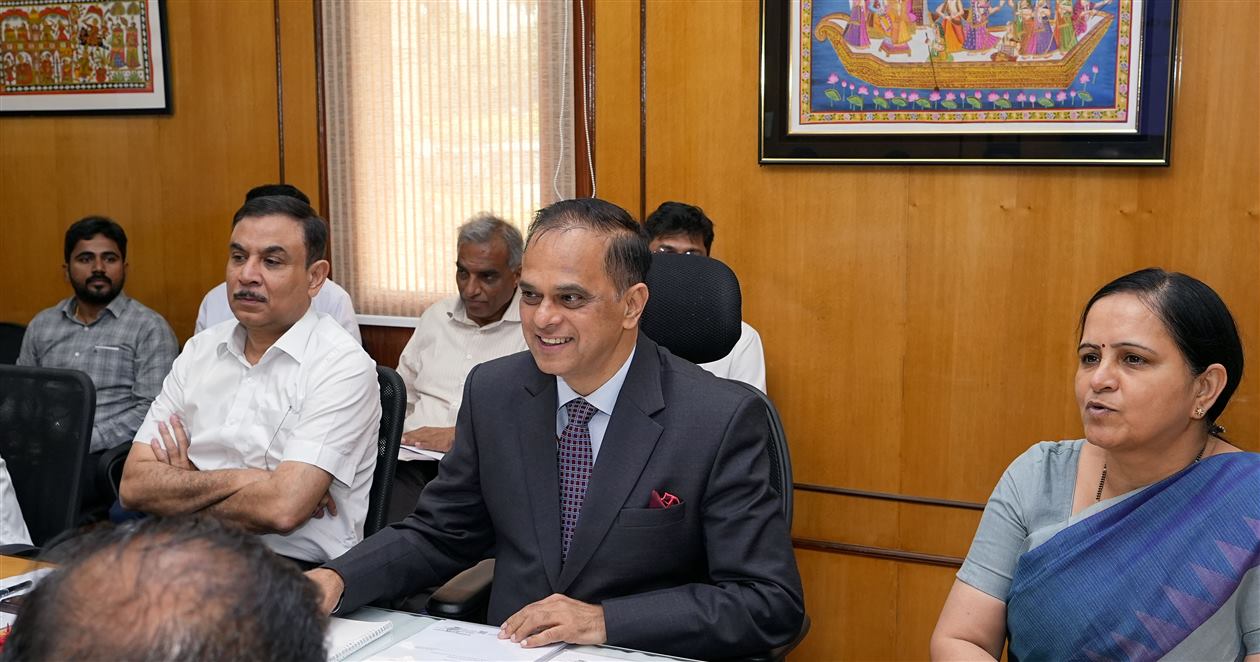
The Chief Secretary was chairing a stakeholder meeting on the development of agro-processing clusters held at the Government Secretariat on Wednesday. He said that the clusters should not be limited to production and processing alone, but should encompass the entire value chain from farm to market. Facilities for sorting and grading, packaging, cold storage, processing, transportation and supply systems, brand development and market linkages should be developed to reduce post-harvest losses and provide farmers with better market access and higher returns.
Shri Srinivas directed NABARD to undertake Farmer Producer Organisation (FPO) mapping to assess the economic potential of the proposed clusters. He also directed the concerned departments to present detailed and implementable cluster-wise action plans in the upcoming review meeting. He emphasised the need to involve start-ups, micro-processing units and the private sector in this initiative, while making optimum use of available resources and support through better coordination among various Central and State Government schemes.
Additional Chief Secretary, Industries, Shri Shikhar Agrawal emphasised the need to attract large agricultural processing enterprises to the State, with a particular focus on value addition and the export potential of agricultural products. He stressed the identification of key exportable agricultural products and their potential markets, as well as linking agro-processing clusters with food parks and the State’s industrial and investment promotion policies. This would encourage private investment and expand the reach of Rajasthan’s agricultural products in national and global markets.
Principal Secretary, Agriculture and Horticulture, Smt. Manju Rajpal informed that 39 food parks have been proposed in the State under the Rajasthan Food Park Development Policy-2026, with land already allocated at 35 locations. At present, the State has agricultural processing infrastructure comprising 2 Mega Food Parks, 4 Agro-Processing Clusters and 6 RIICO/Spice Parks. In addition, there are more than 1,500 agro-processing units and over 1,850 micro food-processing units supported under the Pradhan Mantri Formalisation of Micro Food Processing Enterprises (PMFME) Scheme.
She informed that work is underway to develop 10 agro-processing clusters based on moong, mustard, soybean, kinnow, pomegranate, guava, orange, isabgol, cumin and garlic. Crop-wise and district-wise mapping of the major production areas has been undertaken for these clusters to effectively link production areas with processing facilities and markets.
Horticulture Commissioner Smt. Shweta Chauhan informed that 7 of the proposed 10 clusters are eligible under the Cluster Development Programme (CDP 2.0) of the National Horticulture Board. Concept proposals for three clusters based on guava, pomegranate and cumin have already been submitted, while four clusters based on isabgol, kinnow, garlic and orange are proposed to be taken up in the next phase. Work is underway to promote the mustard, soybean and moong-based clusters through food parks, investment agreements and various State Government schemes.
Officials and experts from the Ministry of Food Processing Industries, Government of India; Industries and Commerce, Finance, Agriculture and Horticulture Departments; Rajasthan State Agricultural Marketing Board; National Horticulture Board; NABARD; various institutions of the Indian Council of Agricultural Research (ICAR); Chaudhary Charan Singh National Institute of Agricultural Marketing; and agricultural universities of the State, along with investors engaged in agricultural processing and progressive farmers, participated in the meeting.